
Marubozu Candlestick Pattern – Momentum Signal Guide
Candlestick patterns are one of the simplest ways to understand market sentiment, and the Marubozu is among the clearest of them all. It represents strong momentum – either bullish or bearish – with no hesitation from market participants. If you want to understand trend strength, breakouts, or possible reversals, the Marubozu candlestick pattern can be a powerful tool.

In this guide, we’ll break down what a Marubozu is, how it works, how traders use it, and the mistakes you should avoid.
What Is a Marubozu? – Definition
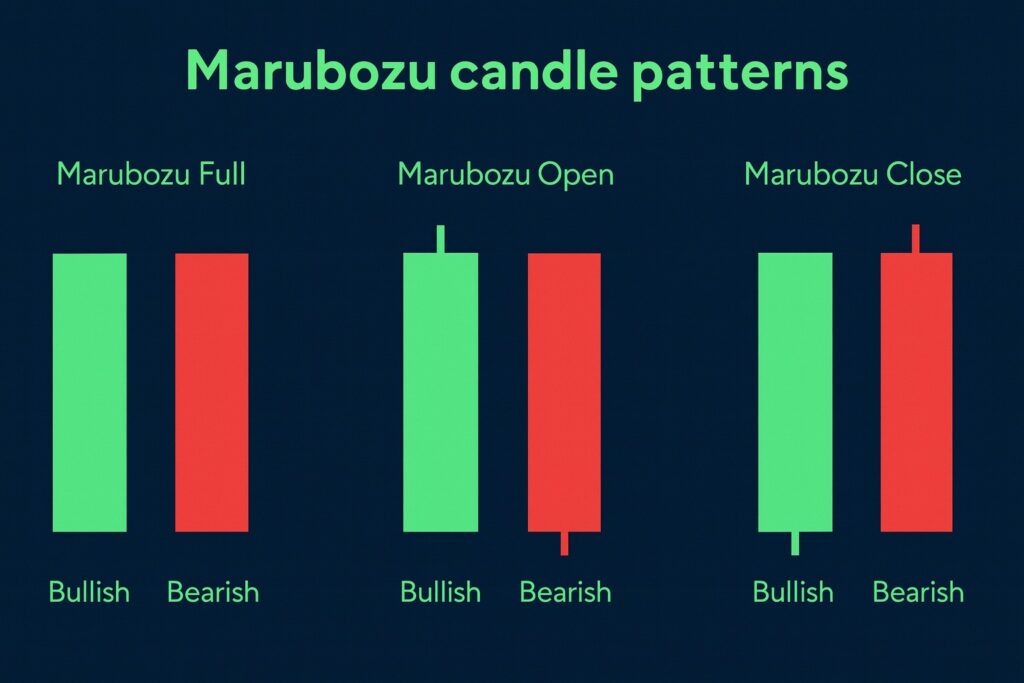
A Marubozu is a candlestick with no wicks (shadows) or extremely tiny wicks. This means the price opened at one extreme and closed at the other, showing complete dominance by either buyers or sellers.
- When the candle has no upper or lower shadow, it shows pure momentum in one direction.
- It signals strong conviction, often appearing during breakouts or the start of large moves.
In simple terms:
Marubozu = Full-body candle = No doubt in market sentiment.
Types of Marubozu Candlestick Patterns
1. Bullish Marubozu
A Bullish Marubozu forms when:
- Price opens at the low
- Closes at the high
- Body is long and full, with almost no wicks
This shows buyers controlled the entire session, often signaling:
- Start of an uptrend
- Breakout above resistance
- Continuation after a pullback
2. Bearish Marubozu
A Bearish Marubozu forms when:
- Price opens at the high
- Closes at the low
- Body is full and long
This shows sellers dominated the market, often indicating:
- Start of a downtrend
- Breakdown below support
- Continuation of bearish momentum
Candle Structure
A true Marubozu has:
- Open = Low for bullish / Open = High for bearish
- Close = High for bullish / Close = Low for bearish
- Zero or very tiny wicks
- Long candle body, larger than recent candles
Although textbook examples have zero shadows, modern markets often show small wicks due to volatility. Still, the message remains the same – strong control by one side.
How to Trade the Marubozu Pattern
Here are practical strategies used by traders:
1. Breakout Strategy
- A Marubozu forming above resistance or below support confirms momentum.
- Enter in the direction of the breakout.
- Place stop-loss below/above the candle body.
2. Trend Continuation
- In an existing trend, a Marubozu often appears at strong continuation points.
- Buy after a bullish Marubozu in an uptrend.
- Sell after a bearish Marubozu in a downtrend.
3. Pullback Entry
- Wait for a slight retracement after the Marubozu forms.
- Enter when the price retraces 30–50% of the candle body.
4. Momentum Trading
- Ideal for day traders and scalpers.
- Enter immediately after confirmation (next candle staying above or below the Marubozu).
Volume & Confirmation
Volume matters a lot with Marubozu patterns.
- High volume = strong conviction, reliable signal
- Low volume = weak signal, risk of fakeout
Confirmation tools:
- Support/resistance
- Trendlines
- RSI/MACD
- Market structure (BOS, CHOCH)
- Volume spikes
Avoid entering trades only because you saw a Marubozu — always confirm direction.
Common Mistakes Traders Make
❌ Trading Marubozu without confirmation
Signals can fail in sideways markets.❌ Ignoring volume
A strong candle with low volume may be manipulation.❌ Entering at the top or bottom
Always wait for pullback or confirmation.❌ Using Marubozu alone
Combine with trend, support/resistance, or indicators.❌ Placing tight stop-losses
Marubozu candles are large – tight SL will get hit easily.
Summary
The Marubozu candlestick pattern is a simple but powerful signal of market momentum. It shows whether buyers or sellers dominated the session, making it useful for identifying breakouts, trend continuation, or strong reversals. However, like all candlestick patterns, it must be traded with confirmation and proper risk management.
Frequently Asked Questions (FAQ)
1. Is a Marubozu reliable?
Yes, when combined with volume and market structure. Alone, it can be misleading.
2. Do Marubozu candles always indicate trend continuation?
Often yes, but in some cases they appear at the end of exhaustion moves. Always confirm.
3. Can Marubozu appear on any timeframe?
Absolutely – works on 1-minute charts to weekly/monthly charts.
4. How do I set a stop-loss?
Place it below (bullish) or above (bearish) the Marubozu body or 30–50% retracement level.
5. Are small-wick candles considered Marubozu?
Yes, as long as wicks are very tiny and body shows strong dominance.

