
Introduction
The Indian stock market is a dynamic and essential part of the country’s financial system, offering millions of Indians the opportunity to participate in wealth creation and the nation’s economic growth. For newcomers, however, investing can seem complicated, surrounded by jargon, technology, and risk. This comprehensive guide breaks down the Indian stock market for beginners, explaining how it works, the vital roles of the NSE (National Stock Exchange) and BSE (Bombay Stock Exchange), the process of investing – including Demat account India basics and provides practical advice on starting your investment journey. Whether you are wondering how to invest in Indian stock market, seeking stock exchange basics, or trying to understand NSE trading hours, this post aims to offer step-by-step clarity, trusted resources, and actionable tips for the Indian context in 2025.

Understanding the Indian Stock Market Basics
The Indian stock market operates as a regulated marketplace where shares of publicly-listed companies change hands between buyers and sellers. At its core, owning a share means you have a tiny stake in a company; as the company grows and profits, so can the value of your investment. The stock market doesn’t just enable personal wealth creation – it’s a vital funding engine for Indian businesses, channeling savings into growth and innovation.
Stock exchange basics involve understanding key terms:
- Stock: A unit of ownership in a company.
- Equity: The value of an ownership interest.
- Share Market vs Stock Market: Used interchangeably in India; both refer to places where securities (stocks, bonds) are traded.
- Primary Market: Where companies raise new funds via Initial Public Offerings (IPOs).
- Secondary Market: Where existing shares are traded among investors on stock exchanges.
- Indices: Report cards for the market, such as Nifty 50 (NSE) and Sensex (BSE).
- Demat Account: An online account that holds your shares electronically, replacing physical certificates.
Anyone who meets age and KYC documentation requirements can open a Demat account India and start participating.
Stock prices in India move according to demand and supply, influenced by factors such as company performance, economic growth, industry trends, investor sentiment, and global events. For example, good company results or positive news about India’s economy often trigger upward price movements, while negative reports or global shocks can cause declines.
Stock exchanges are regulated by the Securities and Exchange Board of India (SEBI), which ensures investor protection and market efficiency.
NSE & BSE: India’s Leading Stock Exchanges
National Stock Exchange (NSE) Overview
The National Stock Exchange of India (NSE), headquartered in Mumbai, is the country’s largest exchange by trading volume and market capitalization. Established in 1992, the NSE brought revolutionary changes to Indian stock trading by becoming the first fully automated, electronic exchange in India. By eliminating paper-based and outcry trading, NSE set new standards of transparency, speed, and investor access.
Key facts about NSE (2025):
- Over 2,600 companies listed, total market cap above $5.3 trillion (as of June 2025).
- Home to the widely tracked Nifty 50 index, representing India’s top 50 blue-chip companies.
- The world’s largest derivatives exchange by contracts traded, a hub for futures and options.
- High trading volume and liquidity – favored platform for active traders, institutional, and retail participants.
- Trading entirely electronic with advanced infrastructure and nation-wide access.
- NSE trading hours: Monday to Friday, 9:15 AM to 3:30 PM IST (with pre-opening from 9:00–9:15 AM).
The broad product range includes equities, derivatives, currency, bonds, ETFs, mutual funds, and newly introduced innovation segments (such as social and SME listings). NSE trading hours are consistent across products, making it easier for beginners to plan their trading routine.
NSE’s Key Contributions:
- Deep liquidity (easy to buy/sell most large stocks at stable prices).
- LED the way on technology and market reforms.
- Developed indices, investor education, and robust risk controls.
NSE’s continuous innovation and market leadership have made it the default stock exchange for a majority of India’s retail and institutional investors.
Bombay Stock Exchange (BSE) Overview
Founded in 1875, the Bombay Stock Exchange (BSE) is not just India’s first but also Asia’s oldest stock exchange. Based on Dalal Street in Mumbai, BSE is known for its historic role in India’s corporate expansion, wide coverage of listed companies, and being the technological pioneer of its time.
Key facts about BSE (2025):
- Over 5,600 companies listed – more than any other exchange in the world.
- Total market capitalization of about $5.5 trillion (as of June 2025).
- Benchmarked by Sensex, an index tracking the top 30 companies across all sectors.
- Full suite of securities: equities, bonds, derivatives, mutual funds, and SME listings.
- BSE market hours: Monday to Friday, 9:15 AM to 3:30 PM IST.
The BSE provides strong appeal for retail investors, traditional traders, and for those seeking to invest in India’s small and mid-cap companies less represented on the NSE. BSE continues to evolve with new products like commodity and bond platforms, an international exchange in GIFT City, and expanded mutual fund services.
BSE’s Key Contributions:
- Larger universe of listed companies, especially SMEs.
- Home of the Sensex – one of the nation’s most followed business indicators.
- Deep penetration among retail and long-term investors.
Differences Between NSE and BSE
While both NSE and BSE serve the same fundamental purpose, a close understanding of their differences helps beginners decide which may be best for their trading and investment goals.
| Feature | NSE (National Stock Exchange) | BSE (Bombay Stock Exchange) |
| Year Established | 1992 | 1875 |
| Location | Mumbai | Mumbai |
| Benchmark Index | Nifty 50 (Top 50 companies) | Sensex (Top 30 companies) |
| Number of Listings | ~2,600+ | ~5,600+ |
| Market Cap | $5.3 Trillion+ (June 2025) | $5.5 Trillion+ (June 2025) |
| Trading Volume | Higher—favored by active and institutional investors | Lower vs NSE; strong in SMEs/mid-caps |
| Technology | Pioneer in electronic trading (since 1994) | Adopted electronic trading after NSE |
| Liquidity | Highest liquidity, tight spreads | Slightly lower liquidity overall |
| Product Range | Equities, F&O, currency, ETFs, mutual funds | Equities, F&O, debt, commodities, mutual funds |
| Target Users | Traders, institutions, volume-based trading | Investors, traditional traders, small companies |
| Trading Speed | Fastest (4-6 microsecond latency) | Fast, competitive |
| International Profile | Top 5 globally, huge derivatives hub | Asia’s oldest, largest listed company universe |
Choosing Between NSE and BSE:
- For liquidity, derivative trading, and speed – NSE is preferred, especially for new and active investors.
- For broader small-cap and SME exposure – BSE can be appealing; also, some stocks may list only on BSE.
- Most large stocks are listed on both, and share prices are nearly aligned thanks to arbitrage.
In practice, your brokerage account will let you trade on both exchanges. For beginners, NSE is commonly recommended due to technology, liquidity, and educational resources, but BSE’s legacy is equally important for diversity and historical context.

How to Invest in Indian Stock Market: Step-by-Step Guide
Embarking on your investment journey in the Indian stock market is more accessible than ever in 2025. Here’s a simplified, actionable process answering the crucial question: How to invest in Indian stock market?
1. Gather Your Documents
You’ll need:
- PAN card (mandatory for all financial transactions in India)
- Aadhaar card (for identity/address verification)
- A savings bank account (to fund your investments)
- Recent photograph
- Canceled cheque or bank statement
Online-only onboarding has made this process fast for all major brokers.
2. Select a Stockbroker
You cannot invest directly on NSE/BSE; you must go through a SEBI-registered stockbroker. Choose your broker based on reliability, fees, trading platforms, and support. Considerations include:
- Discount brokers (like Zerodha, Upstox, Groww): Low-cost, easy apps, self-service, ideal for most beginners.
- Full-service brokers (like ICICI Direct, HDFC Securities, Kotak): Provide advisory and research, but at higher fees.
Here’s a comparison of leading brokers:
| Broker | Account Opening Charges | Brokerage (Delivery / Intraday) | Annual Fees | Best For |
|---|---|---|---|---|
| Zerodha | ₹200 | ₹0 / ₹20 per order | ₹300 | Lowest fees, active trading |
| Upstox | ₹0 | ₹20 per order | ₹0 (1yr) | Beginners, app-based trading |
| Groww | ₹0 | ₹20 or 0.05% per order | ₹0 | Simplicity, first-timers |
| Angel One | ₹0 | ₹20 per order | ₹240 (2nd yr) | Research support, diversified |
| ICICI Direct | ₹0 | 0.55% / 0.275% | ₹700 | Full-service, research, advisory |
| Kotak Sec. | ₹0 | ₹20 per order (plan) | Up to ₹600 | Bank-linked, full-service |
Each platform offers robust apps and web dashboards, research tools, and educational content. For beginners with small amounts or less frequent trading, zero/low-charge brokers like Groww or Upstox are user-friendly. For those wanting deep advice or to invest larger sums, full-service brokers add value.
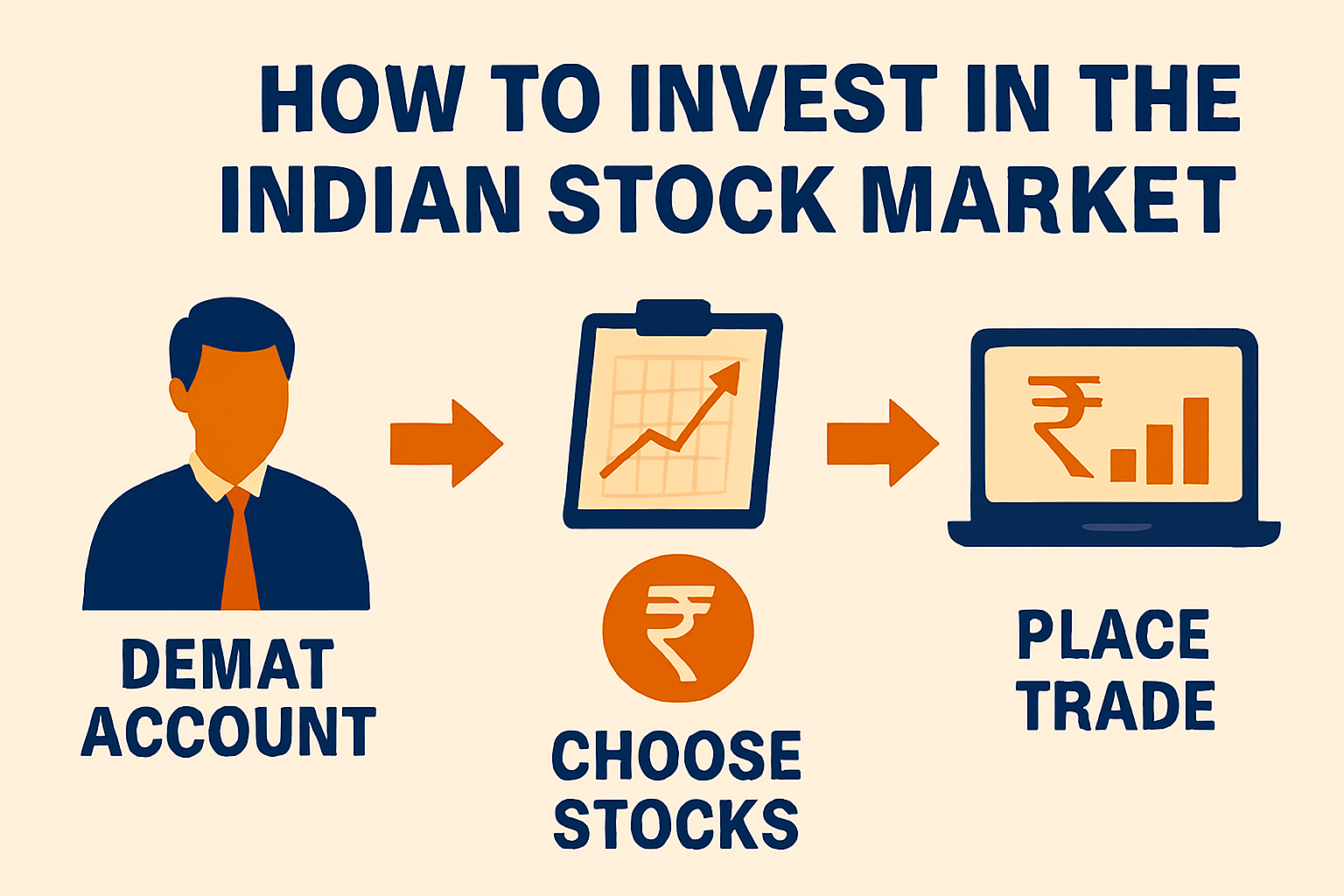
3. Open Your Demat Account and Trading Account
A Demat account India is mandatory to participate in the stock market. “Demat” stands for “dematerialized” – it keeps your shares in electronic form, just like a bank account holds money. Your trading account is used to place buy/sell orders.
- Many brokers offer combined Demat + trading accounts, opened online via e-KYC.
- KYC process: Upload scanned documents, fill online forms, complete a quick in-person verification (via video call or selfie).
- Most accounts are opened within 24-48 hours.
Demat Account India basics:
- Your Demat account is held with NSDL or CDSL (the two government depositories).
- It’s secure, easy to monitor, avoids paperwork and risk of physical certificate loss.
4. Add Funds & Start Trading
- Transfer money from your bank to your broker’s trading account via UPI, net banking, or NEFT.
- Learn your platform/app’s interface – most brokers offer dummy trades for practice.
- Start with small, safe investments: blue-chip stocks or index funds (Nifty 50, Sensex funds).
- Place your first order: choose the quantity, set a market/limit order, and confirm.
- Once the trade settles, your shares appear in your Demat, and you can track them any time.
5. Begin with Blue-Chip Stocks, Index Funds, or Mutual Funds
If you’re unsure about which stocks to pick first:
- Index Funds/ETFs: Purchase a basket of India’s top companies (like Nifty 50 ETFs); diversified and low cost.
- Blue-chip Stocks: Consider stable giants like HDFC Bank, Reliance, TCS, HUL.
- Mutual Funds: Professionally managed, require less research, best for hands-off investors.
A sensible beginner’s split is: 60% in Nifty 50 index fund, 30% in a large-cap SIP mutual fund, and 10% in 1-2 blue-chip shares to learn and observe.
6. Develop Good Habits
- Avoid bulk investing in a single go; use SIPs (Systematic Investment Plans) to invest monthly and average out market volatility.
- Track your portfolio periodically but avoid daily over-monitoring to reduce emotional reactions.
- Gradually learn to analyze companies using P/E, ROE, profit margins, and debt-to-equity ratios.
NSE Trading Hours: When and How to Trade
Understanding NSE trading hours is crucial for planning your investments and trading activities. Indian exchanges share the same core operating hours:
Indian Stock Market Trading Hours (NSE/BSE) for Equities
- Pre-opening session: 9:00 AM – 9:15 AM
- 9:00–9:08: Place, modify, or cancel orders.
- 9:08–9:15: Price discovery and order matching; no new/trading orders.
- Normal trading session: 9:15 AM – 3:30 PM
- All buy/sell trades are executed at live market prices.
- Closing session: 3:30 PM – 3:40 PM
- Final price calculation, no trading.
- Post-market session: 3:40 PM – 4:00 PM
- Limited trades at closing price for certain stocks.
Key Points About NSE Trading Hours
- No trading on weekends (Saturday & Sunday) and official exchange holidays (such as Diwali, Good Friday, major national holidays).
- There is a special “Muhurat trading” session on the evening of Diwali – a symbolic, short session for auspicious trading.
- Other exchanges (currency, commodity) have different or extended hours.
For best results as a beginner, focus on the main trading session – market volatility is highest at the open and close, so many new investors choose to trade mid-session once things settle.

Stock Market Participants: Who Makes the Market Tick?
The Indian stock market is an ecosystem comprising diverse participants, each playing a specific role that impacts price discovery, liquidity, and integrity. Understanding these actors helps you see how your investments fit into the broader market.
1. Investors
- Retail Investors: Individual Indians buying and selling for personal portfolios; now more than 100 million Demat accounts.
- Institutional Investors: Mutual funds, insurance companies, banks, pension funds – investing large sums and often shaping big moves.
- Foreign Portfolio Investors (FPIs): Overseas investment houses and funds – spur market activity, especially in trending times.
2. Companies (Issuers)
Firms that list shares via IPOs and FPOs, raising capital for expansion, innovation, or paying down debt.
3. Intermediaries
- Stockbrokers: Execute trades on your behalf, provide account access, research and educational tools.
- Depository Participants (DPs): Manage your Demat account, process settlements, and securities transfers (NSDL, CDSL are the main depositories).
- Clearing Corporations: Guarantee settlement of trades, reducing risk of default.
4. Exchanges
NSE and BSE provide the infrastructure, rules, and transparency for all market activity. They match buy and sell orders, set price mechanisms, and monitor compliance.
5. Regulators
- SEBI (Securities and Exchange Board of India): Oversees every aspect, from monitoring brokers and companies to punishing insider trading and ensuring investor protection.
6. Market Makers & Analysts
- Market Makers: Provide continuous buy/sell quotes to ensure liquidity in less-traded stocks or derivatives.
- Financial Advisors/Research Analysts: Help individuals and institutions make informed investment decisions.
The Regulatory Framework: SEBI’s Role
SEBI, the Securities and Exchange Board of India, is the market watchdog. Established by the government in 1992, it aims to protect investor interests, foster transparent market operations, and ensure the Indian stock market functions fairly.
SEBI’s Core Functions
- Regulate: Publishes rules for markets, brokers, mutual funds, companies, and intermediaries.
- Surveillance & Enforcement: Detects market manipulation, insider trading, and fraudulent activities with strict penalties.
- Investor Protection: Runs educational programs to avoid scams, provides grievance mechanisms, and mandates disclosure norms.
- Market Development: Encourages innovation (like settlement), investor education, and technological rollout.
- Approval: Reviews and approves IPOs/new product launches.
SEBI’s regular tightening of insider trading checks, circuit breakers for excess volatility, and simplification of account opening have made Indian stock markets safer and more accessible for beginners.
Stock Exchange Basics: Orders and Trading Mechanisms

For those wondering about stock exchange basics, it’s vital to know how actual trades take place and what order types you’ll use.
Placing Your First Share Market Order
- Market Order: Buy or sell instantly at the best available current price.
- Used for fast execution; you may not control the exact buy/sell price if prices are moving quickly.
- Limit Order: Buy or sell at (or better than) a specified price.
- Used for control – you set a price ceiling for buying or a price floor for selling; trade is executed only when the market reaches your trigger price.
When to Use What?
- Market Orders: When you want quick trades in highly liquid stocks.
- Limit Orders: When trading less liquid stocks, or if you want to avoid buying “too expensive” or selling “too low.”
Other advanced order types:
- Stop Loss: Automatically sells your shares if they fall below a certain threshold (limits your losses).
- Good Till Cancelled (GTC): Limit order that stays valid until executed or cancelled.
The Trading Mechanism
All trades occur electronically on the exchanges:
- Orders are matched via order books maintained by NSE/BSE.
- Trades are executed during normal market hours.
- Settlement is T+1 (trade date plus one day) – shares and funds exchange electronically.
- All trades in listed shares must be routed through a broker; direct investor-to-investor trading is not permitted.
Benefits and Risks of Stock Market Investing
The Indian stock market is one of the most powerful tools for long-term wealth generation, but every investment comes with risks.
Top Benefits
- Beat Inflation: Historical compound annual returns of 12–15% have exceeded fixed deposit returns and outpaced inflation.
- Compounding: Early and regular investment leads to exponential growth (the “eighth wonder of the world”).
- Liquidity: Sell your shares at any time, get cash within a day – far more liquid than real estate or gold.
- Small Amounts, Big Potential: Start with as little as ₹500–₹1,000, making it inclusive for all.
- Ownership & Voting Rights: Even a single share conveys part-ownership and a vote in company decisions.
- Diversification: Indian exchanges offer broad access to various sectors, companies, and ETFs.
Key Risks
- Market Volatility: Short-term price swings, corrections, and bear markets.
- Business Performance: Poor financial results, scandals, or regulatory action can erode stock value.
- Emotional Decision-Making: Fear or greed often leads to panic-selling in downturns or “FOMO” investments in hype.
- Concentration Risk: Investing too much in one stock or sector can be costly if that bet goes wrong.
- Scams: Pump-and-dump, manipulation, or fake “tips” (though these are rarer due to SEBI vigilance).
Reducing risk:
- Diversify across stocks, sectors, and funds.
- Research before investing.
- Emphasize long-term growth; short-term market moves are rarely predictable.
- Use stop-loss orders if trading actively.
Common Mistakes for Beginners (and How to Avoid Them)
New investors often repeat the same costly errors. By knowing them, you are ahead of most first-timers.
Top Mistakes
- Investing Without Understanding: Jumping into stocks without learning company basics or market risks.
- Following Stock Tips Blindly: Relying on WhatsApp/Telegram groups, social media, and friends for advice.
- Chasing Hot Trends: FOMO buying into stocks just because they’re rising fast.
- Impatience: Expecting quick riches; the stock market rewards patience.
- Not Diversifying: Putting all your money in a single stock or sector.
- Emotional Trading: Buying out of greed, selling in panic during corrections.
- Overtrading: Frequent buying and selling racks up broker fees and taxes, harming returns.
- Ignoring Taxes: Not accounting for capital gains tax or maintaining investment records.
- Not Reviewing Portfolio: Forgetting to rebalance as circumstances or goals change.
- Copycatting Portfolios: Imitating professional or internet-famous investors without understanding their strategies or risk tolerance.
Strategies to Avoid Pitfalls
- Educate Yourself: Read books, follow reputable financial news, and use broker-provided learning modules.
- Start Small, Stay Disciplined: Invest what you can afford to lose and think in years, not days.
- Diversify: Use index funds, ETFs, or “blue-chips” to limit big losses.
- Avoid Penny Stocks and Tips: Focus on established companies with clear business models.
- Monitor Emotions: Markets fluctuate; stick to your plan.
Broker Selection and Platforms
The right stockbroker is your bridge to wealth creation. In 2025, Indian investors have an abundance of choice.
Choosing the Best Broker
- Discount Brokers: Flat fees, low costs, easy-to-use digital apps (Zerodha, Upstox, Groww, Angel One).
- Best for most beginners and active traders.
- Full-Service Brokers: Higher fees, advisory/research, wealth management, physical branches (HDFC Securities, ICICI Direct).
- Ideal for those seeking handholding.
Factors to Consider
- Account opening/maintenance charges.
- Brokerage fees per trade.
- App and web platform reliability.
- Product range: Equities, ETFs, mutual funds, commodities, global stocks.
- Research, education, and support quality.
- Platform ease-of-use, especially for first-timers.
2025’s Top Brokers Comparison
- Zerodha: Most popular; minimal fees; robust Kite app; strong education.
- Upstox: User-friendly; free/low account fees; large client base.
- Groww: Beginner-friendly; zero account/maintenance fee; mutual fund and US stock access.
- Angel One: Covers all segments; free for the first year; personalized research.
- ICICI Direct/HDFC Securities/Kotak: Reliable, but charge higher fees for their services and advisory.
Platforms & Tools
Most brokers provide:
- App/web-based order placement.
- Account tracking and real-time portfolio analytics.
- Financial statements and ratios on listed companies.
- Tutorials, blogs, YouTube channels for investor education.
- Demo/virtual trading for practice.
Your first Demat/trading account can be opened online, and you’ll be investing within a day.
Conclusion: Your Indian Stock Market Journey Starts Now
The Indian stock market for beginners in 2025 is more accessible, transparent, and inclusive than ever. By understanding stock exchange basics, opening a Demat account India, and mastering the steps outlined in this guide on how to invest in Indian stock market, you plant the seed for financial growth – no matter your starting amount.
Remember:
- Most investors succeed by being in the market consistently, not by timing it perfectly.
- Learn the basics, diversify, avoid “hot tips,” and keep costs low by choosing the right platform.
- Use your first year to build knowledge, patience, and comfort with investing, not to chase fast profits.
- The Indian economy and market remain one of the fastest-expanding globally; participating early exponentially increases wealth potential through compounding.
Read, learn, ask questions, and begin small. The NSE and BSE, with their robust infrastructure and SEBI’s protection, ensure you don’t need to fear making a start. With discipline, a long-term mindset, and this knowledge, your journey in the Indian stock market will be a step toward lasting financial security and wealth.
Ready to begin? Open a Demat/trading account, start with your first investment, and let the magic of compounding and economic growth do the rest!

Very informative article! Learning from the best stock market institute in India helps traders understand market behavior and avoid common mistakes through structured guidance and practical exposure. You can also explore more here: https://acmt.in